China Top Screw Dry Vacuum Pump Manufacturers
China has become a major manufacturing base for industrial vacuum equipment, supported by strong machining, motor, electronics, and export networks. This article examines China’s top Screw Dry Vacuum Pump manufacturers through product capability, engineering experience, quality systems, and service coverage.
Market reports indicate steady demand. Grand View Research identifies semiconductor, chemical processing, pharmaceutical, and packaging industries as important vacuum-pump application sectors. Its industrial vacuum pump analysis also points to continued growth in automation and clean manufacturing. MarketsandMarkets similarly links vacuum technology demand with semiconductor fabrication, where stable pressure control protects sensitive production steps.
The details matter. A well-designed Screw Dry Vacuum Pump should deliver oil-free operation, reliable compression, low maintenance, and consistent performance under changing loads. Buyers should inspect ultimate pressure, pumping speed, power consumption, cooling design, noise levels, and spare-parts availability. ISO 9001 certification helps, but certification alone cannot prove long-term field reliability.
Real performance appears on the factory floor. Stainless-steel screws must resist corrosion from moisture, solvents, and process gases. Clearances must remain stable after repeated thermal cycles. Operators also need practical access to filters, seals, and inspection points.
This guide compares leading Chinese suppliers using publicly available company information, technical documentation, industry reports, and customer-oriented evaluation criteria. Some manufacturers publish limited performance data. That limitation deserves attention. Laboratory figures may not match results in dusty, humid, or chemically demanding environments. Careful buyers should request test conditions, warranty terms, reference installations, and commissioning support before selecting a supplier.
Screw Dry Vacuum Pumps: Working Principles and 10⁻³ mbar Performance
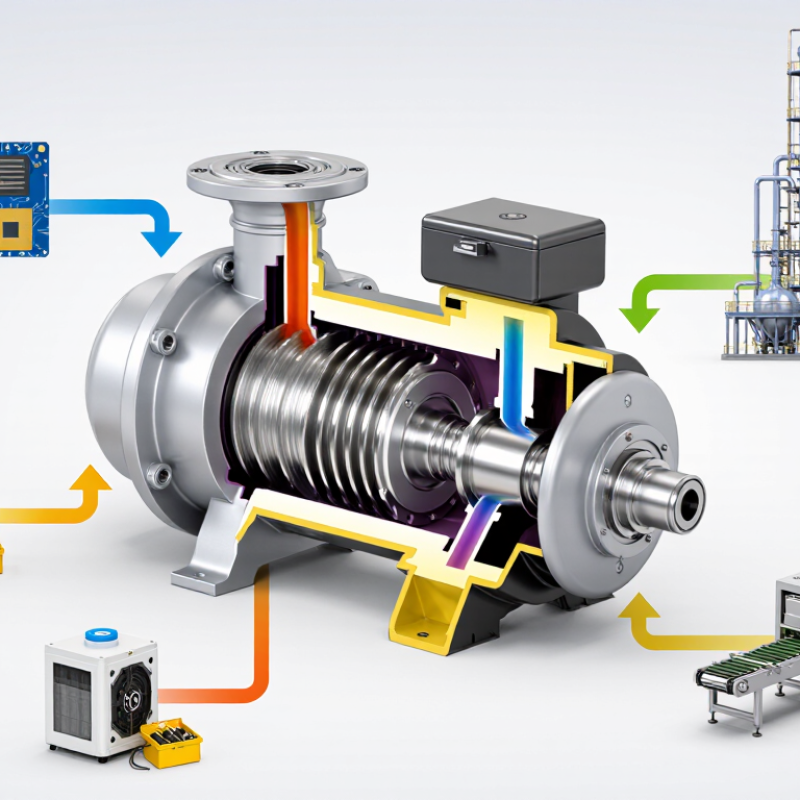
Screw dry vacuum pumps compress gas with two counter-rotating, non-contacting screws. Gas enters the inlet, moves through shrinking chambers, and exits at atmospheric pressure. No oil reaches the compression space. This design reduces backstreaming and simplifies contamination control.
A pressure of 10⁻³ mbar equals 0.1 Pa. That level is achievable with suitable screw geometry, clean seals, and low gas loading. ISO 21360-1 specifies methods for measuring pumping speed and ultimate pressure. Its measurement framework matters because empty-chamber results can differ sharply from operating conditions. In practice, water vapor, leaks, and warm surfaces often delay the final pressure. Small details matter.
The 2023 Global Vacuum Pumps Market analysis by Grand View Research identifies semiconductor, chemical, and analytical equipment as major demand areas. These applications commonly require stable low pressure, not only a low number on the gauge. A pump may reach 10⁻³ mbar during a dry test, yet perform poorly with solvent vapor or frequent cycling. Engineers should record inlet temperature, gas composition, isolation time, and ultimate pressure. Field experience shows that neglected exhaust lines can create unexpected backpressure. The specification is not the whole story. Calibration also deserves scrutiny.
China’s Top Manufacturers: Profiles, Production Scale, and Product Lines
China Top Screw Dry Vacuum Pump Manufacturers
China’s top screw dry vacuum pump manufacturers usually serve semiconductor, chemical, pharmaceutical, food, and laboratory applications. Their profiles often combine engineering teams, precision machining workshops, testing departments, and export service offices. Some operate large production bases with automated machining, while others rely on flexible assembly lines for customized orders.
Production scale varies widely. High-capacity facilities may produce several hundred pump units monthly, supported by CNC machines, rotor balancing equipment, and controlled assembly rooms. Smaller manufacturers can respond faster to special inlet sizes, coating requirements, or control configurations. However, capacity claims need careful checking. Factory visits, audit records, and sample testing provide stronger evidence than sales brochures.
Product lines commonly include single-stage and multistage screw pumps, air-cooled and water-cooled models, and systems for rough or medium vacuum ranges. Typical options include variable-frequency drives, temperature monitoring, gas ballast functions, and corrosion-resistant materials. Practical experience matters here. A pump tested with clean air may perform differently with solvent vapor, dust, or moisture.
Maintenance access is another important detail. Removable covers, clear oil-free sealing structures, and accessible filters can reduce service time. Noise and vibration data should be measured under defined conditions. Some specifications remain unclear, and that deserves questioning. Buyers should compare pumping speed, ultimate pressure, power use, warranty terms, spare-part availability, and commissioning support before selecting a manufacturer.
Key Specifications: 100–2,000 m³/h Pumping Speed and Ultimate Pressure
China Top Screw Dry Vacuum Pump Manufacturers
Screw dry vacuum pumps are commonly specified between 100 and 2,000 m³/h. This range suits semiconductor support, chemical processing, food packaging, and central vacuum systems. According to Grand View Research’s Vacuum Pumps Market report, industrial demand is being driven by cleaner processing and lower maintenance needs. Pumping speed, however, is not constant. It can fall sharply near ultimate pressure.
Ultimate pressure often ranges from about 0.01 to 1 mbar, depending on screw geometry, temperature, gas ballast, and inlet conditions. Some advanced designs reach lower pressures, but published figures are not perfectly comparable. ISO 21360-1 requires standardized methods for measuring pumping speed and pressure. Ask manufacturers for test-gas details, operating temperature, and stabilization time. A large 2,000 m³/h rating may still perform poorly with solvent vapor or restricted pipework.
Tips: Compare curves, not headline numbers. Check the pressure at your actual flow rate. MarketsandMarkets’ industrial vacuum equipment analysis also highlights energy use and lifecycle maintenance as major buying factors. Review motor efficiency, oil-free sealing, cooling demand, and service intervals. One practical mistake is sizing only by chamber volume. Leak rate, vapor load, and cycle time matter too. This deserves careful review.
China Top Screw Dry Vacuum Pump Manufacturers — Key Specifications
Representative specification classes for industrial screw dry vacuum pumps, covering nominal pumping speeds from 100 to 2,000 m³/h. Ultimate pressure values vary with inlet conditions, gas ballast, purge settings, and test standards.
Interpretation: Larger screw dry vacuum pumps generally provide higher throughput, while typical ultimate pressure improves from approximately 50 Pa to 10 Pa across the illustrated capacity range. The values shown are representative engineering specifications rather than data from a specific company or brand.
Industry Standards: ISO 21360, CE Compliance, and Leak-Rate Testing
China Top Screw Dry Vacuum Pump Manufacturers increasingly compete on measurable compliance, not catalogue claims. SEMI reported global semiconductor manufacturing equipment sales of about US$117.1 billion in 2024, increasing pressure for stable, contaminant-free vacuum systems. ISO 21360-1 defines consistent methods for measuring pumping speed, ultimate pressure, and test conditions. Buyers should request the complete test setup, including gas type, inlet pressure, temperature, and instrument uncertainty.
CE compliance also requires careful interpretation. CE marking indicates conformity with applicable European Union requirements; it is not a universal quality certificate. A reliable manufacturer should provide a Declaration of Conformity, risk assessment, technical file access, and traceable component records. The European Commission’s Blue Guide stresses that manufacturers remain responsible for compliance, even when testing is outsourced. That detail matters.
Leak-rate testing exposes weak workmanship quickly. Helium mass-spectrometer testing can identify microscopic leaks around welded joints, shaft seals, and flanges. ISO 20485 describes tracer-gas leak-testing principles, while acceptance limits should match the process requirement. A practical factory report should show test pressure, helium concentration, calibration date, and measured leak rate. Numbers without conditions are incomplete. I would also question “zero leakage” claims; every measurement has a detection limit. Better evidence includes repeated tests, recorded repairs, and a final result below the agreed specification.
Selection Criteria: Corrosion Resistance, 24/7 Duty, and Energy Efficiency
China Top Screw Dry Vacuum Pump Manufacturers
Selecting a screw dry vacuum pump requires more than comparing ultimate pressure. Corrosion resistance comes first in chemical, pharmaceutical, and semiconductor service. Process vapors can attack exposed metal surfaces within weeks. Look for stainless-steel gas paths, suitable coatings, controlled purge gas, and effective condensate drainage. Ask for compatibility data under your actual temperature, vapor concentration, and cleaning cycle. Generic claims are weak evidence.
For 24/7 duty, inspect the operating history, not only the catalogue rating. A dependable pump needs stable bearing temperatures, overload protection, thermal management, and accessible maintenance points. Continuous operation also exposes small design weaknesses. Request test records, service intervals, vibration limits, and restart performance after emergency stops. ISO 20816 vibration guidance can support acceptance checks, although it does not replace site testing. Redundancy may matter more than a lower purchase price.
Energy efficiency deserves a measured comparison. The International Energy Agency estimates motor-driven systems consume about 53% of global electricity. A variable-speed drive, correctly sized motor, low-leakage clearances, and efficient cooling can reduce wasted power. Compare energy use at real throughput, not only at ultimate vacuum. The U.S. Department of Energy also identifies motor systems as a major industrial electricity load. Still, efficiency labels can mislead. I would verify kWh per operating hour, maintenance energy, and performance after months of contamination. A small data gap remains a serious selection risk.