How to Choose an ODM O Rubber Ring Manufacturer in 2026?
Choosing an ODM O Rubber Ring Manufacturer in 2026 requires more than comparing unit prices. The right partner should understand sealing performance, material behavior, tooling control, and production consistency. A ring may look perfect on a sample tray, yet fail after heat, pressure, oil, or repeated compression.
Rubber technologist John S. Dick, author of Rubber Technology, offers a practical warning: “Rubber performance depends on the entire formulation, not the polymer alone.” This principle matters when reviewing an ODM supplier. Ask about compound design, hardness tolerance, compression set, temperature resistance, and batch traceability. Request test records, not attractive promises. Small details matter.
A capable ODM O Rubber Ring Manufacturer should convert your drawing into a reliable production system. Examine its mold design process, first-article inspection, laboratory equipment, and corrective-action records. Confirm whether engineers can recommend EPDM, NBR, silicone, FKM, or another compound for your actual environment. The cheapest quotation may hide unstable tooling or inconsistent mixing.
Look closely.
Factory evidence is stronger than polished brochures. Visit the production floor when possible. Check how operators store compounds, inspect flash, and package finished rings. Certifications can support trust, but they do not replace technical evidence. I have seen supplier evaluations focus heavily on paperwork while overlooking dimensional drift between batches. That mistake deserves reflection.
This guide explains how to compare manufacturers, verify claims, and reduce avoidable sourcing risks in 2026. The process is not flawless. However, disciplined questions can reveal whether a supplier is truly capable of dependable ODM production.
Define Your ODM O-Ring Requirements and Application Conditions
How to Choose an ODM O Rubber Ring Manufacturer in 2026?
Define Your ODM O-Ring Requirements and Application Conditions
A reliable ODM project begins with precise application conditions, not a general request for “a durable O-ring.” Describe the sealing medium, operating temperature, pressure range, movement, and expected service life. Include shaft speed, exposure to sunlight, cleaning agents, and vibration when relevant. These details guide compound selection and prevent unsuitable prototypes. I have seen projects fail because the drawing ignored groove dimensions. Small gaps can cause leakage.
Specify inner diameter, cross-section, hardness, tolerances, surface finish, and compression limits. State whether the ring is static, reciprocating, or rotating. Your manufacturer should review these requirements using material data, dimensional checks, and application testing. Ask for sample inspection records and clear revision control. A neat specification can still miss real operating changes. Recheck it against actual equipment conditions.
Tips: Share photographs of the sealing area, operating data, and failure examples. Mark critical dimensions clearly. Request test samples before approving mass production. Discuss inspection frequency, packaging, traceability, and change notification. Avoid choosing only by unit price; inconsistent hardness or flash may create costly downtime. Be honest about unknown conditions, too. A thoughtful manufacturer should identify missing information, suggest practical tests, and explain trade-offs without making unsupported claims.
Verify Material Selection, Standards, and Manufacturing Capabilities
How to Choose an ODM O Rubber Ring Manufacturer in 2026?
Selecting an ODM O rubber ring manufacturer starts with material verification, not attractive samples. Ask how the supplier matches compounds to temperature, pressure, chemicals, and compression conditions. NBR may suit oils, while EPDM often performs better with water and weather exposure. FKM can handle higher temperatures, but it may not fit every budget or application. Request compound data, hardness ranges, and batch traceability. Samples can mislead.
A reliable manufacturer should understand recognized standards, such as ISO 3601 and ASTM D2000, when they apply to your product. Confirm testing methods for dimensions, tensile strength, elongation, compression set, and leakage. Ask for inspection records, calibration details, and clear acceptance limits. A certificate alone is not enough. Its source and test scope matter.
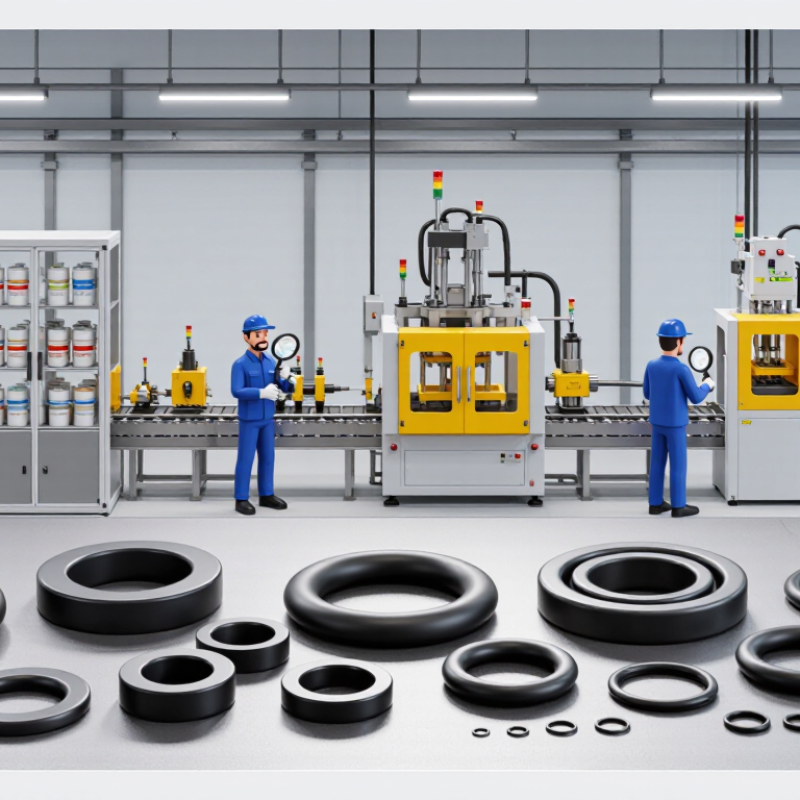
Manufacturing capability also deserves close review. Check whether the factory controls mold design, mixing, molding, trimming, cleaning, and final inspection internally. Visit the production area if possible. Look for controlled storage, labeled batches, and instruments used beside the line. I have seen excellent prototypes fail during volume production because mold wear was ignored. Ask how the supplier handles tooling changes, rejected parts, and corrective actions. Details matter. A strong partner explains limitations honestly, even when the answer is inconvenient.
How to Choose an ODM O-Ring Manufacturer in 2026?
Verify material selection, applicable standards, and manufacturing capabilities before approving an O-ring supplier.
How to read this chart: The values show commonly published typical continuous upper-temperature limits used for initial elastomer screening. Actual performance depends on compound formulation, media compatibility, pressure, compression, and aging conditions. Confirm the final compound with test data and batch-level documentation. For supplier qualification, check dimensional control against ISO 3601, material classification and test methods such as ASTM D2000, traceability, mold capability, flash control, inspection equipment, and production validation.
Evaluate Quality Control, Testing, and Certification Systems
When selecting an ODM O-ring manufacturer, inspect its quality system before reviewing its catalog. The ISO Survey 2022 recorded 1,265,216 ISO 9001 certificates worldwide. Certification shows structure, not perfect production. Ask for the certificate scope, audit date, and site address.
A capable supplier should trace each batch from compound mixing to packing. Request incoming-material checks, FTIR identification, Mooney viscosity, cure-curve testing, and hardness records.
For finished rings, review dimensional inspection, tensile strength, elongation, compression set, and fluid-resistance results. ISO 3601, ASTM D2000, ASTM D395, and ASTM D471 can provide useful testing references.
A sample report should identify the compound grade, batch number, test temperature, and actual result.
Certification must match the application. ISO 9001 suits general quality management, while ISO 13485 may fit medical-device supply chains. Automotive projects may require IATF 16949 controls. Ask whether testing is performed internally or by an accredited laboratory. A clean-looking report can still hide weak sampling. I would inspect three recent batches, not one approved sample. Check how nonconforming rings are quarantined, investigated, and corrected. Some records may be incomplete; that is not automatically disqualifying, but vague answers deserve careful reflection. A practical audit should also include a leak test using the actual mating groove, pressure, temperature, and lubricant.