
How to Choose a Rapid EV Charger in 2026?
Choosing a Rapid Ev Charger in 2026 is no longer a simple race for the highest power rating. Drivers now expect predictable charging, clear pricing, and dependable performance in real conditions.
A 350 kW label may look impressive beside a motorway. Yet your vehicle may accept only 150 kW, especially when the battery is cold or nearly full. Connector compatibility matters too. Check whether your car uses CCS, NACS, or another approved standard. Then examine continuous output, cooling design, payment options, warranty terms, and published uptime. Small details matter. A payment terminal that fails in heavy rain can ruin a carefully planned journey.
Brent Gruber, former Senior Director of Global Automotive at J.D. Power, said, “The public charging infrastructure is still not as reliable as it needs to be.” That warning remains useful when comparing suppliers. A serious Rapid Ev Charger should offer transparent maintenance records, remote diagnostics, and accessible customer support. Look for evidence from independent testing, fleet operators, and verified site users, rather than relying only on promotional claims. Ask how the charger performs at freezing temperatures, during peak demand, and after repeated daily use. These questions expose weaknesses.
This guide explores the practical choices behind a reliable installation. It considers charging speed, electrical capacity, vehicle compatibility, safety certification, operating costs, and site conditions. Some recommendations may not fit every driver. That is the point. The best charger is not always the fastest model; it is the one that works consistently when the battery is low, the weather is unpleasant, and time matters.
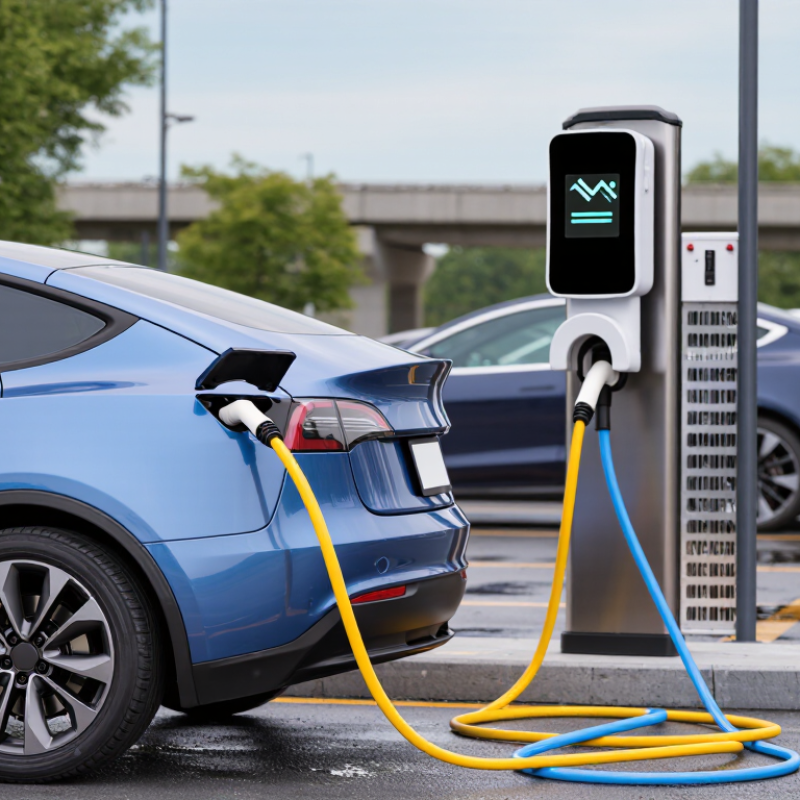
What Is a Rapid EV Charger and How Does It Work?
A rapid EV charger delivers electricity much faster than a standard home charger. Most rapid units use direct current, or DC. The station converts grid electricity before sending it directly to the vehicle’s battery. This bypasses the car’s onboard AC charger. The vehicle and charger communicate continuously. Battery temperature, charging level, voltage, and current all affect the real speed.
Charging is usually fastest below about 80% battery capacity. It then slows to protect the cells and reduce heat. A higher power rating does not guarantee faster charging. The vehicle may accept only 100 kW, even when the charger offers 250 kW. In 2026, check the car’s maximum DC input, connector type, cable design, and charging curve. Maintenance records and safety certification also matter. A clean screen means little if the equipment is poorly maintained.
Tips: Compare average charging time, not only peak power. Arrive with a warm battery when the vehicle supports preconditioning. Keep space around the cooling vents. I used to compare charger numbers alone. That was too simplistic. Power sharing can reduce speed when several vehicles charge together, so site capacity deserves attention. Look for clear pricing, working payment methods, and visible emergency instructions.
| Evaluation Dimension | Typical Data or Range | What It Means | Selection Guidance |
|---|---|---|---|
| Definition of a rapid EV charger | Usually a DC charger delivering approximately 50 kW or more | It supplies direct current to the vehicle battery instead of relying mainly on the vehicle’s onboard AC charger. | Confirm the vehicle’s maximum DC charging rate before paying for higher output. |
| AC charging comparison | Approximately 3.6–22 kW, depending on the vehicle and electrical supply | AC power is converted to DC by the onboard charger inside the vehicle. | Choose AC for overnight, workplace, or long-stay charging; choose DC for rapid travel stops. |
| Common DC power classes | 50–149 kW: rapid; 150–349 kW: high-power; 350 kW and above: very high-power | Higher rated power can reduce charging time, but only when the vehicle and battery can accept it. | For most passenger vehicles, 100–200 kW is often a practical balance between speed, site cost, and vehicle capability. |
| Charging process | Grid AC → power electronics → controlled DC output → battery management system | The charger and vehicle continuously exchange information about voltage, current, temperature, and battery limits. | Select equipment that supports recognized communication and safety requirements for the target vehicle market. |
| Typical charging voltage | Approximately 400 V or 800 V vehicle systems | At the same power level, a higher-voltage system generally requires less current, which can reduce cable and thermal demands. | Check whether the charger output range matches the vehicle’s battery voltage architecture. |
| Charging connector | Use the regional DC connector standard supported by the vehicle | Physical compatibility and communication compatibility are both required for charging to begin. | Verify connector type, cable reach, locking method, and whether an approved adapter is permitted. |
| Vehicle charging limit | The vehicle may accept less power than the charger’s maximum rating | Actual charging power is limited by the lowest active limit among the charger, vehicle, battery temperature, state of charge, and electrical supply. | Use the vehicle manual or technical specification rather than selecting a charger by output alone. |
| Charging curve | Power is usually highest at a low or medium state of charge and tapers near full charge | The final portion of charging generally takes disproportionately longer than the first portion. | For long-distance travel, charging from about 10% to 80% is often more time-efficient than charging to 100%. |
| Illustrative charging-time calculation | 60 kWh battery charged from 10% to 80% requires approximately 42 kWh | Ideal time is calculated as energy required ÷ charging power: 42 kWh ÷ 50 kW ≈ 50 minutes; 42 kWh ÷ 150 kW ≈ 17 minutes. | Treat these figures as theoretical estimates; real sessions are longer because of tapering, battery temperature, and conversion losses. |
| Energy efficiency | Charging losses commonly occur in the power electronics, cables, cooling system, and battery | Energy drawn from the grid is higher than the energy stored in the battery. | Compare measured energy delivered, standby consumption, and efficiency data under realistic operating conditions. |
| Thermal management | Air-cooled or liquid-cooled cables and power modules | Cooling helps maintain safe temperatures during sustained high-power charging. | For frequent high-power use, evaluate thermal derating, cable weight, cooling noise, and maintenance requirements. |
| Electrical installation | Requires suitable grid capacity, protection equipment, earthing, isolation, and often three-phase supply | The site’s available electrical capacity can be lower than the charger’s nameplate rating. | Obtain a site assessment and check local electrical codes before installation. |
| Safety and compliance | Relevant requirements may include IEC 61851, local electrical regulations, residual-current protection, and overcurrent protection | Safety systems detect insulation faults, overtemperature, abnormal voltage, connector problems, and communication errors. | Use certified equipment installed and commissioned by qualified professionals. |
| User authentication and payment | Contactless payment, mobile application, QR code, account login, or vehicle-based authentication | The available payment method affects convenience, access, and transaction reliability. | Choose a charger with at least one simple payment method and a clear display of price and session status. |
| Connectivity and monitoring | Ethernet, cellular, Wi-Fi, remote diagnostics, usage records, and software updates | Connectivity allows operators to monitor availability, energy use, faults, and pricing remotely. | For commercial sites, prioritize open communication protocols, remote support, cybersecurity, and data export. |
| Outdoor durability | Look for suitable ingress protection, impact resistance, corrosion resistance, and operating-temperature ratings | Outdoor equipment must withstand rain, dust, temperature changes, accidental impact, and repeated use. | Match the enclosure and connector ratings to the local climate and installation environment. |
| Best use case | Highway stops, fleet depots, taxi operations, service areas, and locations with short dwell times | Rapid DC charging is most valuable when vehicles need meaningful range added in a limited period. | Select power based on expected dwell time, traffic volume, vehicle mix, grid capacity, and total operating cost. |
Which Charging Speed and Power Rating Fit Your EV?
How to Choose a Rapid EV Charger in 2026?
Charging speed should match your EV’s battery, onboard charger, and daily driving pattern. A 60 kWh battery receiving 7 kW AC may need about nine hours in real conditions. An 11 kW unit can reduce that time, if the vehicle supports three-phase charging. A 22 kW charger is not automatically faster. Many EVs accept only 11 kW AC.
For highway travel, DC charging matters more. The International Energy Agency’s Global EV Outlook 2024 reported more than four million public charging points worldwide in 2023, with public charging expanding rapidly. A 50 kW DC charger may add useful range during a short meal break. A 150 kW charger is more practical for larger batteries and long-distance driving. However, the vehicle’s peak rate controls the result. A charger rated at 350 kW cannot force a 100 kW EV to charge faster.
Check the charging curve, not only the headline number. Some EVs reach peak power briefly, then slow near 80 percent. The U.S. Department of Energy’s Alternative Fuels Data Center also notes that charging time varies with battery temperature, state of charge, and equipment limits. Cold weather can make the advertised speed feel disappointing.
I would choose reliable 100–150 kW DC access for frequent travel, rather than pay extra for unused power. That judgment is not perfect. Your route, parking time, and electrical supply may matter more than maximum speed.
How to Compare Connector Types, Compatibility, and Charging Networks
How to Choose a Rapid EV Charger in 2026?
Choosing a rapid EV charger starts with the connector, not the advertised power. Check your vehicle’s charging port and maximum DC charging rate in the manual. Common options include CCS1, CCS2, the North American Charging Standard, and CHAdeMO. A physical fit does not guarantee full compatibility. Some vehicles need an approved adapter, while others cannot use certain charging protocols. Check carefully.
Charging speed also depends on battery temperature, state of charge, and station power sharing. A 350-kilowatt charger may deliver far less when two vehicles share its cabinet. In my experience, a charger near 150 kilowatts can be more practical than a faster unit with frequent faults. Real conditions matter. Published figures can mislead.
Compare charging networks by coverage, uptime, payment methods, and roaming access. Look for clear pricing, including connection fees and idle charges. A reliable network should show live status, connector availability, and recent maintenance information. Test the app before a long trip. Weak reception can turn a simple stop into a frustrating wait. Network reviews help, but they are not perfect. A charger working yesterday may fail today. Keep a backup location, especially on unfamiliar routes.
How to Choose a Rapid EV Charger in 2026?
Comparing connector types, compatibility, and typical public DC charging power
The values show commonly deployed upper charging ratings for each connector family, not guaranteed vehicle charging speed. Actual power depends on the vehicle's onboard charging system, battery temperature, state of charge, cable rating, and the charger's site capacity. For rapid charging, confirm that the connector is physically compatible and that the vehicle supports the charger's DC voltage and current range.
What Safety, Reliability, and Smart Features Should You Check?
How to Choose a Rapid EV Charger in 2026?
Safety should be checked before charging speed. Look for certified protection against overcurrent, overheating, voltage surges, and residual current. A visible emergency stop button matters in busy locations. The connector should lock firmly and release smoothly. Inspect the cable, handle, and screen for cracks or loose parts. Check the enclosure’s IP rating, especially for outdoor installation. Good ventilation also reduces heat stress during repeated high-power sessions.
Reliability is more than a long warranty. Ask about tested operating temperatures, dust resistance, component access, and expected uptime. A charger should record faults clearly and support remote diagnostics. Firmware updates should use secure verification. Poor software can still disable excellent hardware. I would also check whether local technicians can replace worn cables quickly. A charger that waits weeks for service is not reliable in practice. That lesson is easy to miss.
Smart features should solve real problems. Dynamic load balancing can prevent a site from exceeding its electrical limit. Charging schedules can reduce demand during expensive periods. User authentication, payment controls, and usage reports help operators manage access. Choose systems with open communication standards, clear data policies, and dependable network backup. Test the mobile interface before buying. It may look polished, yet fail when the signal is weak. Leave room for doubt, and verify every advertised feature under realistic conditions.
How to Evaluate Installation Costs, Location, and Long-Term Value?
Choosing a rapid EV charger starts with the site, not the advertised power rating.
The International Energy Agency reported more than four million public charging points worldwide at the end of 2023, after public infrastructure grew by over 40% that year. Competition is increasing, but poor placement still destroys project value.
Location changes everything. A site near highways may support higher utilization, while an urban site may need slower turnover and longer dwell times.
Check transformer capacity, trenching distance, drainage, parking access, lighting, and local utility tariffs. The U.S. Department of Energy’s Alternative Fuels Data Center warns that installation costs vary widely with electrical upgrades and site construction. My first budget was too optimistic. A load study should come before signing a lease.
Long-term value depends on energy throughput, uptime, maintenance access, and demand charges.
A 350-kilowatt unit can appear impressive, yet remain unprofitable with weak daily utilization. The National Renewable Energy Laboratory’s EVI-Pro modeling also shows that charging demand depends heavily on travel patterns, vehicle adoption, and dwell time.
Build a three-case forecast: conservative, expected, and high-growth.
Include cable replacement, software fees, payment equipment, and future electrical expansion. A spreadsheet can still lie. Recheck its assumptions every year.
Reliability may matter more than peak speed when drivers return to the same location.
Article Source:
Let's Build Together
Contact Us: Call 435-563-3503
-OR- Fill in the form below and we will call you back.